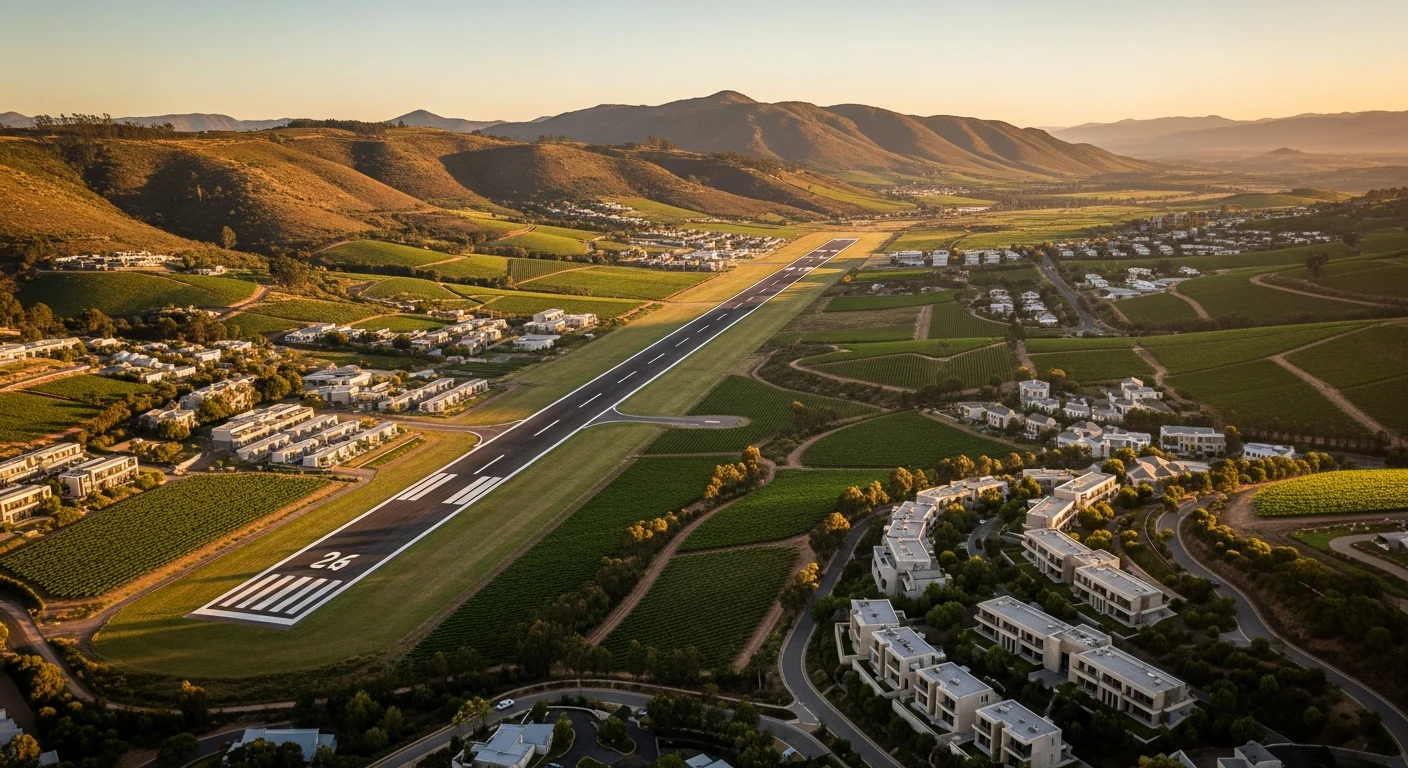
Forget the vineyards for a second, let's talk about tarmac.
If you follow the whispers in the Cape property circles, you know the conversation isn't just about the next vintage. It's about connectivity. There has been significant talk about a regional airport or expanded aviation infrastructure in the Winelands corridor, with Growthpoint Properties now confirmed as investment and managing partner for the R8bn Cape Winelands Airport development. Now, I'm not here to tell you it's a done deal, but if even a fraction of this moves forward, the property map of the Western Cape is going to look very different by 2030.
The community has for decade been watching how infrastructure drives value. When a new highway comes in, or a major node gets a massive retail injection, the surrounding nodes react. An airport isn't just about planes landing; it's about the movement of high-value goods, international executives, and a massive shift in how we view the Paarl, Stellenbosch, and Somerset West nodes.
The industrial ripple effect: Why logistics wins
If you're an industrial investor, this is where you should be paying attention. We've seen how proximity to major transport hubs changes the game. Look at what happened with the expansion of the logistics nodes around Cape Town International. The demand for warehousing didn't just increase; it changed character. We moved from simple storage to high-spec, temperature-controlled, and highly automated facilities.
If a Winelands airport becomes a reality, the Paarl industrial nodes, specifically those along the N1 corridor, become incredibly attractive. I've seen tenants in the Stellenbosch area looking for more space, but they are often hitting a ceiling because the available stock is either too small or too old. A regional airport brings the need for 'last-mile' logistics and air-freight-adjacent warehousing.
The numbers tell a story of scarcity. In recent quarters, we've seen vacancy rates in prime Stellenbosch industrial space staying remarkably low, often hovering below 5%. When you add an airport to that equation, you aren't just looking at more tenants; you're looking at higher rental yields. I've seen landlords in similar regional hubs increase their asking prices by 15-20% once the infrastructure certainty is established. The real opportunity isn't in the big, established parks, but in the secondary nodes that are just close enough to the new hub to benefit from the overflow.
The office shift: Moving away from the CBD
For years, the Cape Town CBD has been the undisputed king of office space. But we are seeing a shift. The 'semigration' trend isn't just about people moving to the Winelands to retire; it's about businesses moving their operations closer to where their people live.
I've had many conversations with business owners in Stellenbosch who are tired of the commute into the city. They want high-quality, Grade A office space that feels like the Winelands, not a concrete jungle. An airport provides the final piece of the puzzle for international firms. If a CEO can fly into a regional hub and be in a boardroom in Stellenbosch within 20 minutes, the CBD loses its primary advantage.
We are already seeing a trend of 'flight to quality' in the Winelands. Tenants are willing to pay a premium for buildings that offer better security, better amenities, and better access. If the airport project gains momentum, I expect we will see a surge in demand for boutique office developments in the Paarl and Stellenbosch outskirts. This isn't about massive towers; it's about high-spec, low-density professional spaces.
The infrastructure reality check
I don't want to paint too rosy a picture. There are massive hurdles. You can't just drop an airport into the middle of a wine region and expect no friction. The environmental hurdles are huge, and the local community sentiment can be a powerful force against such developments.
Then there is the road network. Let's be honest: the R44 and the N1 are already under immense pressure. If we increase the volume of heavy vehicles and passenger traffic, the current infrastructure will buckle. I've seen many 'great' property investments fail because the municipality couldn't keep up with the road upgrades required to support the new demand. Any investor looking at this space needs to look closely at the municipal capital expenditure programmes for the Drakenstein and Stellenbosch municipalities. If the roads aren't being upgraded, the airport's value is capped.
My take: Where should you put your money?
If you're asking me what to do with your capital right now, I'd say keep your eyes on the periphery of the existing industrial nodes in Paarl. Don't chase the already inflated prices in the heart of Stellenbosch just yet. Look for the 'in-between' spaces, the land and the older buildings that are ripe for redevelopment into modern logistics or professional office space.
The real winners in any infrastructure boom are the people who buy the 'second-tier' locations before they become 'first-tier.' The airport might be the catalyst, but the value is created in the transition. Watch the zoning changes. Watch the road upgrade announcements. That is where the real margin is hidden.
The practical takeaway: If you are a landlord with older industrial stock in the Paarl/Stellenbosch corridor, start looking at your CAPEX. Modernise your security and your loading bays now. When the interest shifts toward this node, you want your building to be the first one on the shortlist for high-spec tenants.